Just a warning, there's brief mention of abuse and suicidal ideation, but I don't get into detail.
 |
| I highly recommend the series btw |
Naturally a story about art students has a lot to say about being true to yourself and following your passions against all odds, which is a message that speaks a lot to me personally. I could probably write a whole post just about that, but today I'm gonna talk about Yuka.
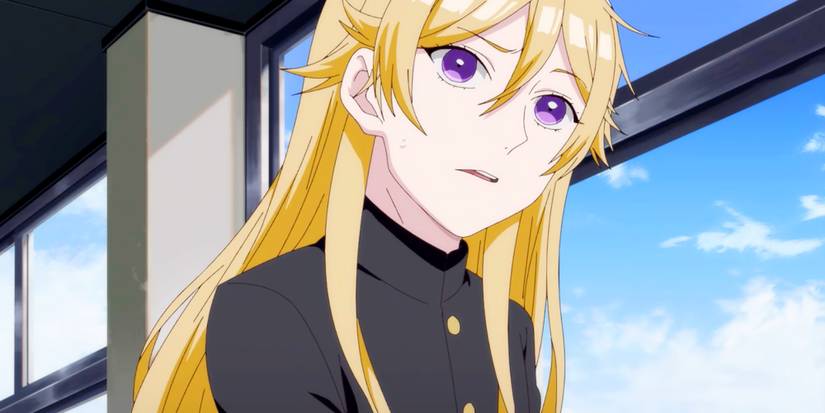 |
| that's yuka |
So funny thing, the first time I watched Blue Period like four(?) years ago I didn't get past episode four. Not because it's bad! I really really liked it! I'm just bad at finishing things and only revisited the series now. But, I remembered Yuka after all these years for their depiction as an openly and explicitly queer character.
Here's the real kicker, four years ago I didn't even know I was queer! A lot has changed since I first started the show, and coming back to the series I was really interested to see how my interpretation of Yuka changed (and maybe get a more solid idea of what their whole gender situation actually was).
Suffice to say, the gender situation is complicated. I do not feel that it is right to put a hard label on Yuka, and although I will be discussing a lot about their identity this post is not about declaring their gender. To that end, I'll mostly be referring to Yuka with they/them pronouns for the sake of not committing to an answer and only sometimes she/her because that answer makes me happy.
With that disclaimer out of the way, let's set some context.
Ayukawa "Yuka" Ryuji is a classmate and fellow art student to protagonist Yaguchi Yatora. They describe themselves and are described by others as a crossdressing male who is attracted to other men. They are confident, a bit abrasive (especially with Yatora), and seemingly indifferent to the opinions of others.
 |
| she's sooooo cool |
Pretty early on we get a couple scenes that further cement what we know about Yuka and their identity. Yatora doesn't really understand Yuka, nor does he really get along with them. He always calls them "Ryuji" which Yuka expressly does not appreciate. Yuka gets flirty with a guy they barely know and sets up a date, only to get rejected and heartbroken once they make it clear they're a crossdresser.
Yatora tries to comfort Yuka, but he doesn't really understand their feelings, even going on to say they'd probably have better luck with romance if they dressed like a guy.

After this point Yuka takes a step back from the spotlight, with the story focusing on Yatora's growth as an artist and preparations for the university acceptance exams. They are occasionally present, but as the series goes on they grow concerningly distant from the main cast, only showing the audience glimpses of their current struggles.
Yuka begins talking, acting, and dressing more femininely. I think Yuka's really cool when they express their femininity, but this is clearly framed by the story as a possibly alarming change in demeanor. They quit art school, face abusive parents at home, and express feelings of wanting to be taken out of the world.
When Yatora reaches out to them, Yuka likens their situation to a person drowning in the sea and challenges him to jump in and drown as well if he really wants to help.
 |
| All this talk of jumping while a train passes ominously by |
An important note for later is how another character interprets and explains this drowning metaphor to Yatora. When a person is drowning in the sea the smart thing to do is grab a lifesaver, but you'd never truly understand that person's feelings unless you experience the suffocating darkness of the ocean yourself.
After a midnight train ride to the beach the two end up having a heart to heart. Separated by a divider, they draw nude self portraits in a cheap motel room. Nudity is a pretty obvious and very often used metaphor for opening up, being vulnerable, and looking at your true self, but I really like how its handled here.
While Yuka explains what's been going on with their life, particularly their struggles with identity and direction, Yatora faces his own insecurities reflected in the mirror.
Yuka sees Yatora as a model student (to an annoying degree), but he sees himself as pathetic and talentless, someone who has to work his ass off just to compete.
Yatora always thought Yuka never cared about others' opinions, but they're actually always worried about what people think. It's a constant struggle for them to be who they want to be, but sometimes they don't even know what they truly want.
This is what it means for Yatora to jump in and drown with Yuka. He is only able to understand their struggles and insecurities by facing himself, and through this understanding they both realize that their perceptions of each other were completely different from their perceptions of themselves.

Yuka goes on to confess that they've loved a girl before, but felt that maybe things would be easier if they only liked men. With his new understanding, Yatora is able to point out that Yuka's increasing performance of femininity may also be a way of "making things easier" by forcing themselves into a category that "makes more sense".
And this is why I don't believe in finding a proper label for Yuka's identity. I know what it feels like to be unsure of who you are or who you want to be.
Is there something transgender going on with me or am I some kind of poser? Do I actually love him or is it all in my head? Maybe it would be easier if someone could diagnose me, put a label on me, so I fit neatly in a box.
But the beauty of queerness is that there's no need for boxes.
Yuka is confident, a rebel who shows the world who they are proudly, and yet they still worry about what the world thinks. In a roundabout way, by embracing their queerness and nonconformity they just ended up trading the label the world tries to force on them with a queer identity they try to force on themselves.
So maybe the technically "correct" answer is that Yuka is a gender nonconforming bisexual man. But my point is that there is no point in settling on an answer like this. To put Yuka in a box like this is to deny their struggles with uncertainty, the nuances of their own personal experiences, and the journey of self reflection we all go through.
Much like an artist can chase their dreams against all odds, you should be free to decide who you are without regards to what the world thinks is sensible. Maybe you aren't sure of your path or maybe your feelings will change with time, but that journey is entirely yours to make.
That is what Yuka's story means to Blue Period and that is why she is literallyyy me fr fr.


No comments:
Post a Comment